
As the future of Mexico’s only aged cheese becomes increasingly uncertain, producers, advocates, and researchers seek to preserve its flavor and history.
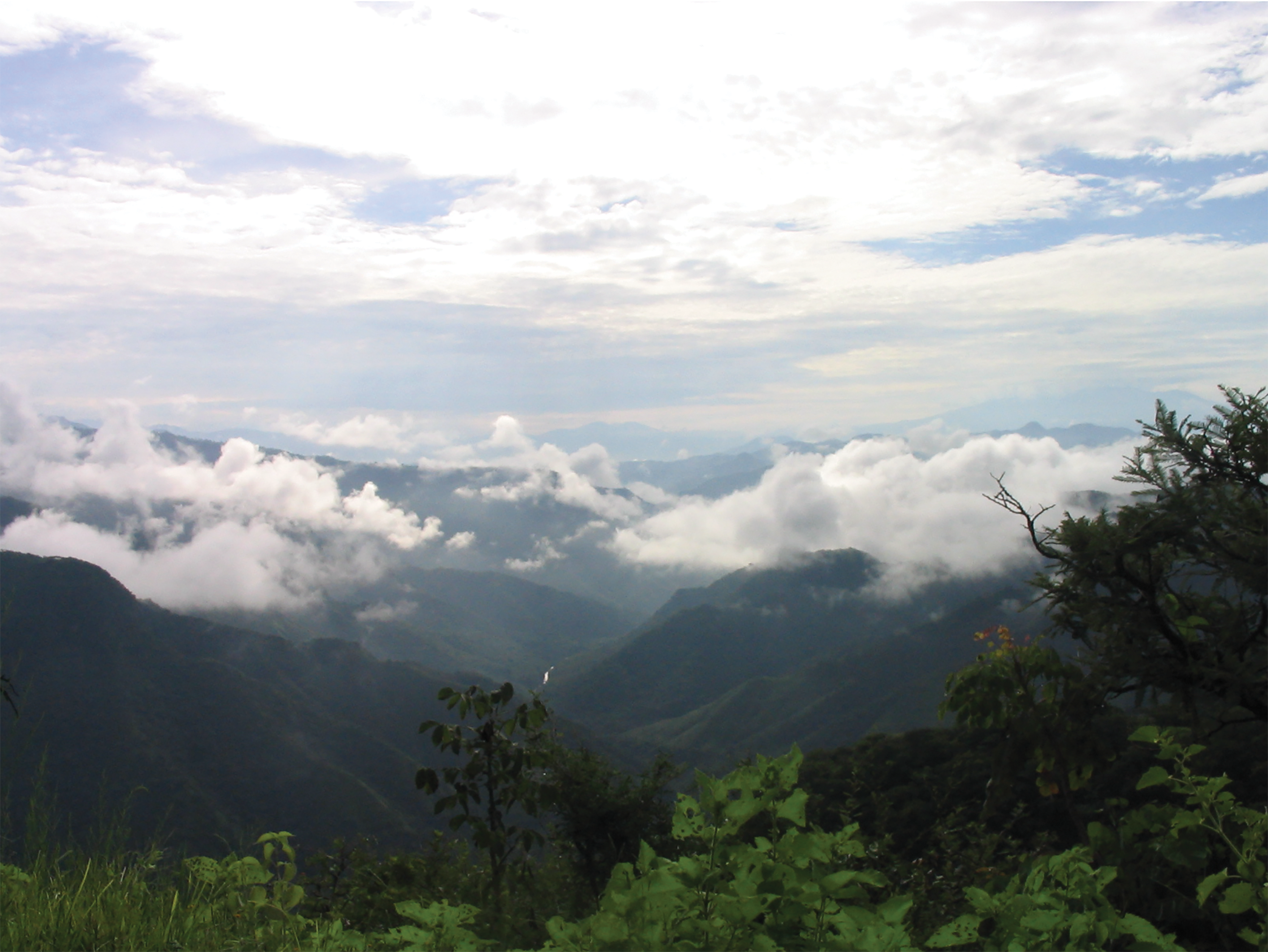
Mountain Cotija’s character and production is defined by the the Sierra Jalmich region’s landscape.

Mountain cotija is aged for at least three months.
There’s a cheese made high in the mountains, where cows graze on lush vegetation that gives its firm, crumbly paste a golden hue. Large wheels are made by hand before they’re brought down to the village for months of aging. Crack one open for a kaleidoscope of assertive aromas: lactic, mineral, vegetal, fruity.
The cheese is Cotija, made by a dwindling number of families in the Sierra Jalmich, a mountain range that straddles the borders of the Mexican states of Jalisco and Michoacán. Mountain Cotija is not the simple, salty white cheese available in the US, nor is it like the versions produced outside of this remote region that are sold under the same name throughout Mexico.
“When you open a wheel, it’s incredibly aromatic. You will sense pineapple, sometimes green apple, banana skin,” says Jessica Fernández López, founder of cheese education platform and consultancy Mexican Mongers.
Mountain Cotija tastes of cultured butter, with a bright acidity and a piquant note of lipase. Wheels aged beyond three months become intensely salty and tangy, developing a bite reminiscent of pecorino. Because of that concentrated flavor, mountain Cotija is often used in dishes like tamales rather than as a table cheese (though for locals, it’s eaten alone as a snack or with an equally bracing sip of mezcal).
Today, production of this rare cheese is declining, and getting your hands on a wedge is becoming increasingly difficult, even in the parts of Mexico where it’s produced. To understand why requires
a look at four centuries of sometimes murky history; decades of advocacy by producers, mongers, and researchers; and the contemporary barriers makers of mountain Cotija face.

Rafael Torres-Torres milks cows by hand to make mountain Cotija.

Mountain Cotija is made from the milk of mixed-breed cows with Zebu genetics.
“THE TRADITIONS OF OUR ANCESTORS”
In the sixteenth century, Spanish miners seeking gold and silver settled in these mountains, bringing dairy animals with them. The hard, salty cheese they made became known for its quality and was even traded as currency. Cotija became a gastronomic point of pride in Mexico, the sole aged cheese in a dairying tradition that began with colonization.
Mountain Cotija is made only during the late summer rainy season, when food for the animals is abundant and humidity is high enough that wheels won’t crack during aging. The cows, a unique mix of breeds that includes the heat-tolerant Zebu, graze on local vegetation high in the mountains. There are no freeze- dried cultures, just naturally occurring lactic acid bacteria, plus calf rennet for coagulation. After cutting and draining, the curd is salted with sea salt from the Colima coast, shaped with a wooden belt lined with cotton or agave fibers, and pressed. Wheels are then aged for at least three months.
“We follow the traditions of our ancestors,” says Rafael Torres-Torres, a mountain Cotija producer and the owner of Rancho Cabras in Quitupan, Jalisco. “The type of cattle, the grass, the altitude, and the climate are all very important.”
Due to its limited production—and prohibitive red tape and importing costs—mountain Cotija is unknown to many cheese lovers in the US. (Ironically, Torres-Torres says that most of the 3,300 to 4,400 pounds of cheese he makes each year from the milk of his 50-cow herd ends up north of the border, purchased in small quantities by those visiting home from the States.)
Since the late 1990s, researchers and public officials have collaborated with producers to better understand the social, economic, and technical aspects of Cotija production and how to preserve this integral piece of Mexico’s dairy heritage. In 2003, a group of advocates petitioned the Mexican government for a denomination of origin similar to the legal regulations that define and protect traditional cheeses in Europe.
Instead, in 2005, they were granted a collective trademark under Queso Cotija de la Región de Origen—the first ever granted to a Mexican heritage food. The trademark was officially registered as an indication of origin detailing standards for Cotija production, including where the cheese can be made and how long it must be aged. However, inferior and mass-produced versions of “Cotija-style” cheese produced in Mexico outside of this designation are still common.

Workers carry milk to be made into cheese.
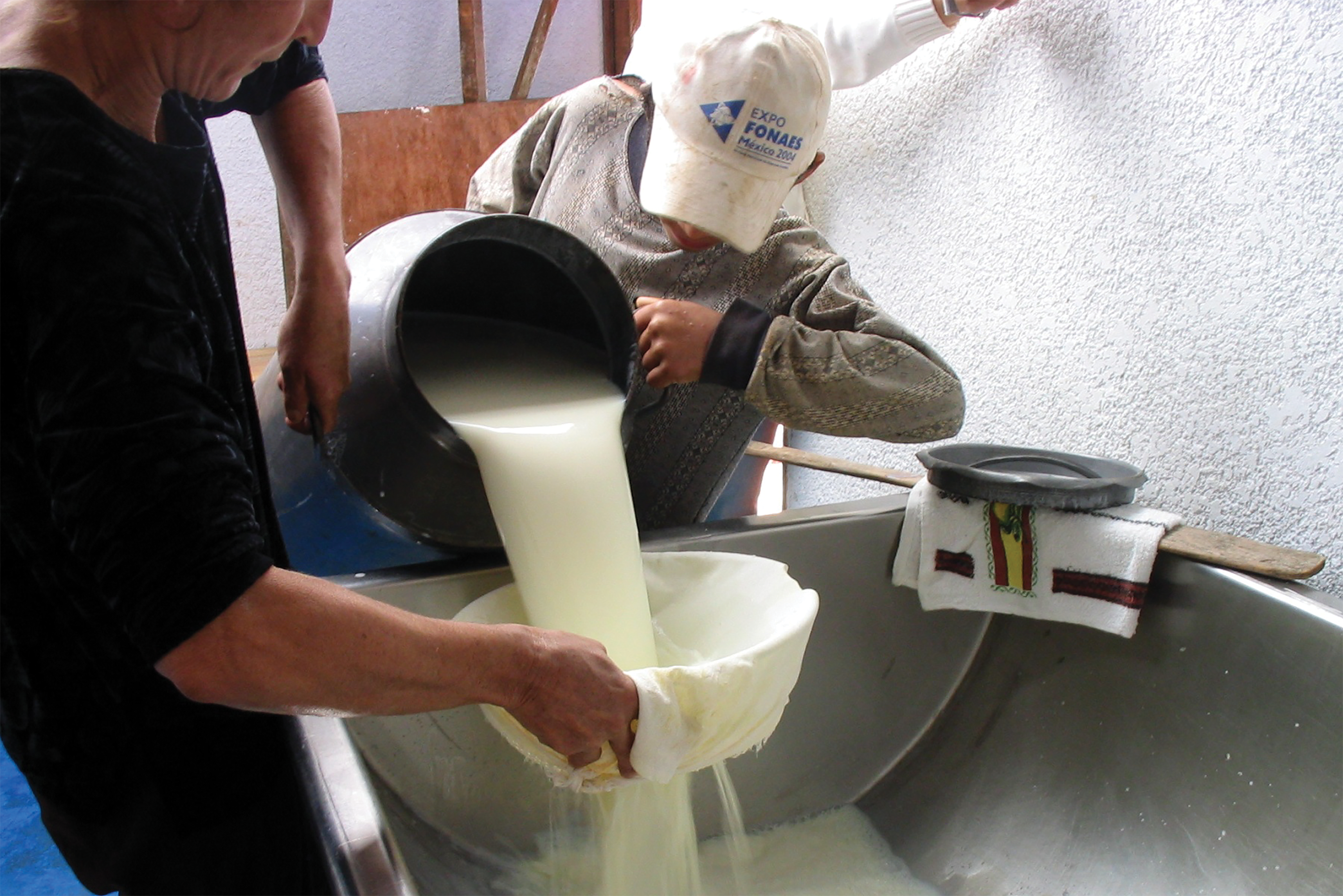
Fresh milk is strained before cheesemaking begins.
MOUNTING CHALLENGES
“If you don’t make it in this special artisanal way, it is going to be lost,” says Dr. María Patricia Chombo Morales of the Center for Research and Assistance in Technology and Design of the State
of Jalisco. Chombo Morales is one of the academics who began researching and working with mountain Cotija producers nearly 30 years ago. “You are going to have industrialized Cotija like we have industrialized tortillas,” she says.
Despite the progress that’s been made—organizing producers, establishing the collective trademark, even scientific analysis of mountain Cotija’s particularly diverse microbiology, which includes more than 500 types of molds, bacteria, and yeasts—odds are stacked against producers of true mountain Cotija. Roads leading to the remote villages where it’s made are poorly maintained and often impassable during the rainy season when the cheese is produced. Climate change is making conditions volatile for farmers, with hotter temperatures and increasingly unpredictable weather. And for almost two decades, cartel violence in the region has intensified, prompting many residents to leave. “We have few people on the ranches right now, and we are producing less and less,” Torres-Torres says. “We are left alone to work. We do it all by hand.”
Even localized improvements would make a big difference in his livelihood and that of his fellow producers. Torres- Torres would like to see the state governments fund road improvements and help producers upgrade facilities to make tasks like milking more efficient while staying true to traditional processes.
These challenges mean there’s less mountain Cotija—and fewer makers— than ever. Chombo Morales estimates that when she began working with producers, there were around 100 families producing the cheese. Since then, she estimates the number has dropped by at least 20 percent.

The time between milking cows and renneting mountain Cotija is often less than three hours.

Torres-Torres shows off the crumbly texture and golden interior of one of his wheels.
PRESERVING THE FUTURE
Fernández López recognizes that mountain Cotija may disappear sooner than anyone hopes. In her view, the desire to preserve “authentic” production practices can conflict with quality of life for those who make the cheese. “The big PDOs of Europe are not fighting with innovation. They evolve all the time,” she says. “But in Mexico, we keep thinking that ‘artisanal’ is breaking your back to make something.”
If making traditional Cotija in the Sierra Jalmich becomes nonviable for farmers like Torres-Torres, Fernández López says, maybe the knowledge could be preserved elsewhere, or the cheese could be made as close to the traditional methods as possible in another region, then one day be brought back to the Sierra Jalmich when conditions have improved. “Perhaps the future of these flavors lies elsewhere, in a different paradigm— one we have not yet conceived,” she adds.
In California, Carmen Licon-Cano, director of Cal Poly Dairy Products Technology Center in San Luis Obispo, sees the need to preserve mountain Cotija’s legacy while also advocating for producers before time runs out. She hoped to replicate the cheese with her students, teaching them about its sensory qualities and history in the process. But the specific information a dairy scientist would use to reverse-engineer a cheese—milk components, culture strains, pH, salt percentages—is limited. “We ended up not making [mountain] Cotija because we couldn’t get a recipe straight,” she says. “There were all these questions that we still have to answer.”
Licon-Cano wonders how academics and advocates on both sides of the border could collaborate to better document mountain Cotija’s production—confirming parameters like make processes and acidity, isolating microorganisms, analyzing samples to pinpoint aromatic compounds via gas chromatography-mass spectrometry technology—so that even if the cheese is made outside its traditional region, its history and at least some aspects of its flavor could live on. “People evolve, cheesemaking evolves, and technology evolves,” she says. “We cannot pretend it’s the same cheese, especially not having the protections available to PDO cheeses. However, we could try to get as close as we can.” She imagines a sort of “cheese bank”—a repository for the building blocks of endangered cheeses like mountain Cotija, where recipes, cultures, sensory information, and other details could be preserved and, if needed, revived.
For his part, Torres-Torres doesn’t see how his cheese could be made in another place and still be mountain Cotija. Every aspect of its production—the people, the plants, the animals, even the microbes— are inextricably tied to the Sierra Jalmich. “You can’t do it just anywhere,” he says. Then, he adds, tongue firmly in cheek: “If you have a ranch and cows and can help me get a visa, I’ll go make cheese there to see what comes of it.”
Alexandra Jones
Alexandra Jones is a writer and recovering cheesemonger based in Philadelphia. Her work on food, agriculture, social justice, and sustainability has appeared in outlets like USA Today, Food & Wine, Atlas Obscura, Civil Eats, The Counter, Audubon, the Philadelphia Inquirer, and Modern Farmer. She’s the author of Stuff Every Cheese Lover Should Know, a pocket guide to cheese from Quirk Books.